
Takeoff in Construction: The Ultimate Guide
If you're a contractor, you might have heard the word "takeoff" thrown around during project discussions. It doesn't involve airplanes, but it is a critical step before your project can actually ‘take off’. A takeoff is simply the process of figuring out exactly how much of each material you'll need for a project.
However, a construction takeoff serves a purpose beyond simply providing the quantity of materials needed for the project. With the ever-increasing rise in construction costs, a precise takeoff is more important than ever. Your estimate - for materials, labor, equipment, time and budget all depends on how accurate your takeoff is in the first place. So, how do you ensure an effective takeoff process?
In this article, we'll talk about what a construction takeoff is, why it is so important, how you do a takeoff, which way is best for you, and more.
So, buckle up and get ready for an insightful read.
What is a Takeoff in construction?
Takeoff in construction is the first step in accurately determining the materials needed to bring a project to life. It's the meticulous process of identifying and quantifying all the materials listed on the project blueprints/plansets. The term “take-off” simply refers to estimators “taking off” each material required for the project from the blueprints. It's like creating a detailed shopping list to ensure you have the right amount of everything from lumber to the electrical conduit.
At its core, a construction takeoff involves meticulous calculations based on four key types of measurements:
- Count: This applies to materials that are typically purchased or installed in individual units. Examples include doors, windows, light fixtures, plumbing faucets, and specific types of hardware.
- Length: This measurement is used for linear materials, such as lumber (boards, studs), pipes (conduit, electrical), and trim (baseboards, crown molding).
- Area: This measurement is crucial for sheet materials like drywall panels, plywood sheets, flooring materials (tiles, vinyl planks), and roofing materials (shingles, metal panels).
- Volume: This measurement comes into play for bulk materials like concrete, gravel, and insulation. Estimators will use blueprint dimensions to calculate the cubic yardage required for each material, ensuring enough is ordered to fill designated spaces.
By diligently measuring and calculating these four elements: count, length, area, and volume, a construction takeoff provides a comprehensive picture of all the materials needed for the project. This information is then used for various crucial tasks, laying the foundation for success throughout the construction process.
Why are construction takeoffs important?
Construction takeoffs aren't just about creating a comprehensive material list; they play a vital role throughout various stages of the construction process. Here’s how:
1. Give Insights on the Quantity of Materials Needed:
With construction takeoff, you can determine the exact quantities of materials that need to be ordered for a project. This allows contractors to plan material purchases effectively, negotiate with suppliers for bulk discounts, and ensure materials arrive on-site when needed. Why is it such a big deal, you might ask?
If you order a larger material quantity than required, it will hurt your profit margins, and you might actually end up losing the bid to your competitor. By knowing exactly what materials are required and when, project managers can streamline procurement, optimize resource allocation, and ensure a smooth workflow throughout the project lifecycle.
2. Accurate Project Budgeting
A precise takeoff forms the foundation for creating realistic project budgets. By accurately accessing material needs, you can avoid nasty surprises down the road. Underestimating materials can lead to cost overruns and project delays while overestimation ties up unnecessary funds. In fact, you might not win the bid in the first place because your quote is significantly higher than the competitors. A well-done takeoff ensures your budget reflects reality, keeping your project on track financially.
3. Improve Project Management
We all have suffered from extremely tight deadlines leading to extended working hours for teams, teams’ morale, and so on. What is the root cause? Somewhere along the line, we overcommit to the things that we have never done before. The same happens with construction takeoff. If you are relying on guesstimation while doing a takeoff, it will likely affect the project timeline and its completion rate.
An accurate construction takeoff can help you understand the types and quantities of materials needed at each construction stage which allow for more efficient project scheduling.
4. Competitive Bidding
You might receive numerous project calls in a day, but you ignore a few of them based on back-of-the-envelope calculations, your schedule, and sometimes intuition. But the question is - How do you make an informative decision to qualify a project? The answer is via a construction takeoff.
And once a contractor decides to bid, they need to be confident in their pricing. Takeoffs play a vital role in this process. By accurately gauging material requirements, contractors can develop bids that accurately reflect their costs. This allows them to submit competitive bids that increase their chances of winning the project. So that you avoid over- or under-bidding.
How is Construction Takeoff Different From Estimation?
You might have heard people interchangeably using the terms construction takeoff and construction estimation. But are they the same? Absolutely not!
A construction takeoff focuses solely on material quantities. It lists out the required materials, their quantity, and coverage area for a project.
On the other hand, construction estimation takes the takeoff quantities a step further. It factors in material costs, labor costs, equipment rentals, and other project overhead expenses to arrive at a comprehensive project cost estimate.
In simple words, takeoff and estimation are two different processes.
- First, takeoff is done to determine the exact quantities of materials required for the project.
- Secondly, estimators determine the estimation of the project based on the takeoff done while also including factors such as labor cost, equipment cost, and other costs.
While takeoff provides the foundation by outlining what's needed for the project, estimation builds upon it to provide a complete picture of the project's costs, enabling informed decision-making and budget planning.

How to Do a Construction Takeoff?
There are two main approaches of doing construction takeoffs: manually doing takeoff by hand or using digital takeoff software. Let’s understand each approach in more detail.
Manual Takeoffs
Before the digital age dawned on the construction industry, manual takeoffs were the industry standard. Unlike its digital counterpart, this established method relies on meticulous handwork and a keen eye for detail. Essentially, it's a manual inventory process, where you are meticulously identifying and quantifying all the materials needed on a construction project based on the project blueprints. This method involves a series of steps to identify and quantify all materials needed to complete a project. Let's explore the breakdown of each step.
1. Reviewing Project Plans and Specifications
This is the first and most crucial step. You'll need a thorough understanding of the project scope before starting with the takeoff. This involves spending time examining project plans and documents like blueprints, architectural drawings, and project specifications. It is important to pay close attention to details like dimensions, trades involved, material callouts, and specific notes from engineers and architects. The more comprehensively you understand the project requirements, the more accurate your takeoff will be.
2. Identifying Required Materials
Once you grasp the project scope, the next step is to categorize the materials needed for the project for each specific trade. This could include materials like; framing lumber for carpenters, electrical conduit and wires for electricians, water utility for utility contractors, and so on. Having a clear breakdown of materials by trade ensures a well-organized takeoff sheet and simplifies the estimation process later.
3. Measuring Elements and Calculating Quantities
This is where the hard work starts. Precision is key when it comes to measuring and calculating quantities for construction projects. Using tools like a scale rule or engineer's scale, you'll measure different parts shown on the blueprints. These could be lengths, like how much electrical conduit is needed, or areas, like the amount of drywall for a wall.
Once you've got your measurements, you will then perform the necessary calculations to determine the total number of each material. For example, to figure out how much drywall a rectangular wall needs, you need to multiply its length by its height, and make sure to subtract any space taken up by windows or doors.
4. Compiling a Takeoff Sheet
The final step involves meticulously compiling all the information you've gathered into a detailed takeoff sheet. This sheet typically includes columns for listing materials by trade, descriptions of each material, unit of measure (e.g., linear feet, square feet), and the calculated quantity for each item. Maintaining a clear and organized takeoff sheet is essential for easy reference during the estimation process and for effective communication with suppliers.
Drawbacks of Manual Takeoffs:
While the manual takeoff method has served the construction industry for years, it's not without its limitations. Let's explore the key challenges associated with manual takeoffs:
- Time-Consuming and Error-Prone: The repetitive nature of manual takeoffs, with its reliance on hand measurements and calculations, can be incredibly time-consuming, especially for complex projects. This can strain resources and delay other crucial project tasks. Furthermore, the risk of human error is ever-present. A single miscalculation or missed measurement can have a domino effect, impacting the accuracy of your entire takeoff and potentially leading to costly problems down the line.
- Inefficiency for Complex Projects: As project complexity increases, the limitations of manual takeoffs become even more apparent. Managing extensive material lists for large or intricate projects can be cumbersome and error-prone using manual methods. The sheer volume of data involved can make it difficult to maintain organization and accuracy.
- Requires Specialized Skills: Effectively performing manual takeoffs requires specialized skills and training. Estimators need a strong understanding of construction practices, blueprint reading, and the ability to perform calculations accurately and efficiently. This can limit the number of personnel who can effectively contribute to the takeoff process.
Digital Takeoff Software: A Modern Approach
In recent years, digital takeoff software has emerged as a powerful alternative to traditional manual takeoffs. These software tools offer a modern approach that can significantly streamline the takeoff process, enhance efficiency, and reduce the risk of errors. Digital takeoff software can be broadly categorized into two types: manual digital takeoff software and automated AI-based takeoff software.
- Manual Digital Takeoff Software: Manual digital takeoff software tools like Bluebeam Revu and Planswift digitize the takeoff process, allowing users to view and mark up digital plans and blueprints, eliminating the need for physical printouts and enabling easier collaboration and sharing. However, users still need to manually click and drag on the electronic plan to measure the materials quantities, which might take hours or weeks depending on the size of the project.
- AI-powered Automated Takeoff Software: Software like Beam AI utilizes artificial intelligence algorithms to analyze project plans, automatically identifying and categorizing materials, eliminating the need for manual work. This reduces the user input needed compared to manual digital takeoff software. Generally, users only had to upload project plans, define the work scope, and the AI takes care of the rest. This frees up valuable time for estimators to focus on other crucial tasks. Here is a screenshot of an auto-generated takeoff for your reference -

Benefits of Digital Takeoff Software:
Construction takeoffs have traditionally been a time-consuming and detail-oriented process. However, digital takeoff software opens the doors to a new frontier. This innovative technology makes the takeoff process much more smooth and efficient. Let's explore the ways digital takeoff software empowers you to achieve faster, more accurate, and streamlined takeoffs.
- Increased Accuracy and Efficiency: Digital tools automate many tasks traditionally done by hand. Software features like digital scaling tools eliminate the need for manual measurements, reducing the risk of human error. Additionally, many programs offer automatic material identification, which can significantly improve the speed and accuracy of takeoffs, especially for complex projects with extensive material lists.
- Reduced Time Spent on Takeoffs: Gone are the days of spending hours hunched over blueprints with a calculator. Digital takeoff software automates calculations and streamlines data entry, allowing estimators to complete takeoffs in less time compared to manual methods. This frees up valuable time for other crucial tasks, such as project planning and cost analysis.
- Improved Collaboration and Communication: Digital takeoff software allows for easy sharing and collaboration between team members and stakeholders. It offers cloud-based storage for takeoff data, enabling easy access and collaboration among project stakeholders, including estimators, project managers, and subcontractors. This fosters transparency and facilitates informed decision-making.
- Cost Savings in the Long Run: While there might be an initial investment in software, the time saved and improved accuracy translate to significant cost savings over time. Reduced errors in material calculations lead to more accurate bids and estimates, minimizing the risk of cost overruns and project delays. Additionally, the efficiency gains from faster takeoffs allow estimators to handle more projects, potentially increasing overall revenue.
Choosing the Right Takeoff Method
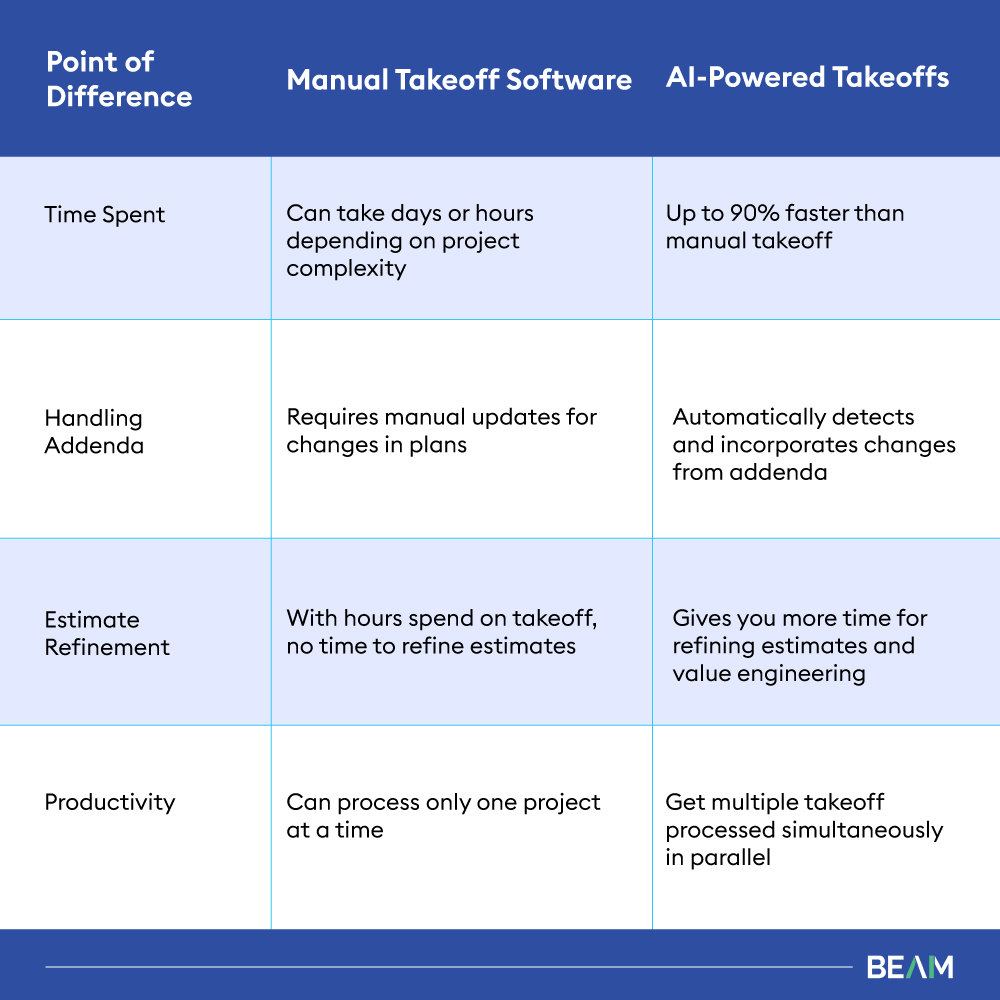
Picking the optimal takeoff method comes down to a few critical aspects. Let's explore these factors to guide your decision:
1. Project Size and Complexity
For smaller projects with simpler designs and material lists, manual takeoff software might seem like a reasonable option. However, even here, factor in the time commitment. If time is important, automated takeoff software can still offer valuable efficiency gains.
For larger projects with intricate designs, extensive material requirements, and multiple trades involved, AI-powered takeoff software becomes highly recommended. As project complexity increases, the automation capabilities of AI software become even more valuable. It streamlines the management of vast amounts of data, ensuring both efficiency and accuracy.
2. Budget Considerations
Digital takeoff software, particularly AI-powered solutions, often require an initial investment through licensing fees or subscriptions. The key is to weigh this cost against the potential time and cost savings the software offers. Consider your typical annual project volume and the estimated time saved using software. Evaluate if those saved hours translate to handling more projects or completing existing ones faster, ultimately boosting revenue.
Remember, when assessing software costs, take a long-term view. The time saved on takeoffs, the improved accuracy leading to fewer errors and change orders, and the potential to handle more projects all contribute to a significant return on investment (ROI) over time.
3. Estimate Refinement
Refining estimates with manual takeoff software can be a hidden cost trap. Manual adjustments are time-consuming and error-prone, potentially leading to rework and budget overruns.
AI-powered takeoff software requires an upfront investment, but it helps you recoup costs in the long run. Faster updates, reduced error risk, and the ability to explore "what-if" scenarios for cost optimization all contribute to significant savings. Analyze your project volume and the potential time saved with AI software to see if the initial investment translates to long-term financial benefits.
4. Team Expertise with Technology
If your team thrives using digital tools and has a basic grasp of construction software, AI-powered takeoff software can be a game-changer. Platforms like Beam AI, for instance, offer user-friendly interfaces, making them accessible even for those without extensive technical knowledge.
Additionally, consider the availability of training and support from the software provider. This ensures your team can maximize the software's capabilities and unlock its full potential.
What do your Customers Expect From You?
Knowing what a client wants can prepare you for the long haul. But what do they actually want from a construction service provider like you? They want to work with a company that is known for efficiency, speed, and work ethic.
The next question you might have is how my company can champion itself in all these factors. We have the answer ready for you; it’s a mix and match of using tech tools, proper project planning, and budgeting.
With fully automated AI-powered construction takeoff software, you don’t need to be worried about keeping track of the takeoff process. The software will take care of that for you. This will give you adequate time to do more bidding and other important revenue-building tasks. Moreover, when you use software to do the takeoff, you can use its insights to outline an accurate construction estimation for a project. You can do all of these before the deadline.
Now that you know how to champion speed, efficiency, and work ethics. Do you plan to go above and beyond to build an ever-lasting customer relationship and to stand out from the rest? You can do so with value engineering analysis. Now, what in the world is that?
Well, it is a way to find a substitute for a material that can do the same functionality, keeping the quality intact, If the definition is not clear, no sweat. An example would do wonders.
Let’s say you need a material “A” that costs $78 to do a functionality “X.” But with value engineering analysis, you find another material “B” of $50 to do the same functionality “X,” which keeps the quality uncompromised.
So, with value engineering analysis, you saved $28.
Imagine what more you can do with it. All these discussed factors will propel your existing market reputation and build a long-lasting customer relationship.
What’s Next in Construction Takeoffs?
The future of the construction industry is full of endless possibilities. Advancements in Artificial Intelligence (AI) and automation have streamlined many aspects of the construction process. We are sure you've heard a lot about "ChatGPT" and "AI". But is there any similar AI tool to do construction takeoff? Yes!
With Beam AI - A fully automated AI-powered construction takeoff software, you can automatically identify materials from blueprints and generate highly detailed takeoffs. This enables you to shift focus from the time-consuming takeoff process to strategic tasks like refining your bids and winning more projects. Book a free trial today to see the power of fully automated takeoff software.
FAQs
What is Quantity Takeoff in Construction?
A Quantity takeoff lists the amount and types of materials required to cover a surface or edges for a construction project.
Who Executes the Construction Takeoff Process?
For major construction companies, estimators do all the construction takeoff and estimation tasks. And for some construction companies, project managers do all the end-to-end construction takeoff tasks.
Can I Use Construction Takeoff Software for Free?
Free takeoff software might not be efficient and is less capable of doing high-power calculations. But if you opt for our Beam AI software, your first takeoff is on us! This will allow you to differentiate between the low-grade free version and a paid high-quality one.
Can I have Construction Material Takeoff in Excel Template?
Yes, you can share takeoff reports in PDF, Excel, and jpeg format. An Excel format will give you the list of materials, their quantity, and coverage for a project.



Subscribe to our quarterly email newsletter
Get the inside scoop — AI breakthroughs, trade secrets, & construction expert tips, all crafted for you & delivered straight to your inbox.